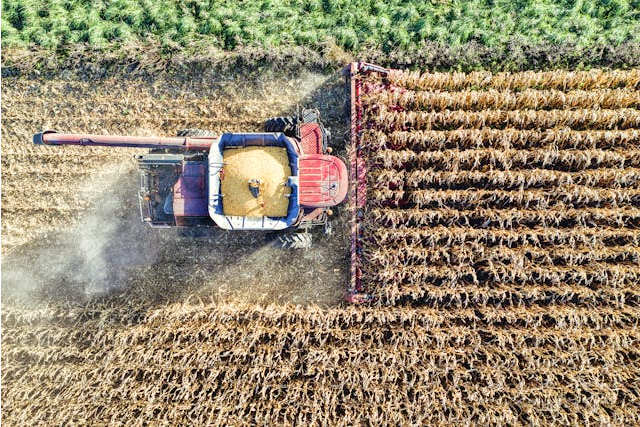
As we move through 2026, global agriculture stands at a crossroads. The post-pandemic funding frenzy is over. Climate volatility is no longer a future threat—it is a daily operating reality. And geopolitical fractures are redrawing trade routes overnight.
Yet within this turbulence lies transformation. Across five major trendlines, a new agricultural paradigm is emerging: one defined not by extraction and excess, but by resilience, data intelligence, and decentralized coordination.
Here is what every stakeholder—from smallholder farmers to agtech founders—needs to understand about global agriculture in 2026.
1. Capital Moves Upstream: The End of the Delivery App Era
For the first time in a decade, venture capital is flowing away from farm-to-fork delivery platforms and toward the farm itself.
According to AgFunder's Global AgriFoodTech Investment Report 2026, overall agrifoodtech funding held relatively flat at $16.2 billion in 2025. But the composition shifted dramatically. Upstream startups—those operating on the farm or in early production—saw a 7% year-over-year increase, reaching $9 billion in total funding .
Meanwhile, the era of billion-dollar grocery delivery mega-rounds has ended. The largest deal in 2025 was Wonder's $600 million Series D—which, as the report notes, "in 2021, it would have been a footnote" .
Debt financing also reached its highest share in a decade at 18.2% of total funding, signaling that agrifoodtech companies now have revenue profiles sophisticated enough for lenders to underwrite .
What this means for AgriGuildDAO: Capital is finally recognizing that real value lies upstream with producers. Decentralized finance (DeFi) instruments and DAO-governed funding pools are positioned to fill gaps left by traditional venture capital, especially for smallholder cooperatives.
2. Data Is the New Fertilizer: AI and Predictive Analytics Go Mainstream
At the Bloomberg Farm, Food & Fuel event in São Paulo, executives delivered a clear message: the sector no longer loses competitiveness due to a lack of scale. It loses it when decisions are made too late, with incomplete information, and without adequate protection .
Independent data and standardized metrics have moved from "supportive" to strategic.
The European Patent Office reports that digital agriculture technologies are growing at an average annual rate of 9.4% —about three times the average rate of other technological fields . From satellite-based field intelligence to AI-driven yield forecasting, data has become as essential an input as fertilizer.
The International Grains Council has also launched the Smart Global Grains Trade Challenge 2026, backed by Microsoft AI for Good, to accelerate digital, data-driven, and AI-enabled solutions across the global grains trade .
What this means: The infrastructure for predictive agriculture is maturing. For decentralized organizations like AgriGuildDAO, this creates an opportunity to aggregate farmer data into collective intelligence—turning individual insights into bargaining power.
3. Geopolitics and Climate: The New Risk Reality
The World Economic Forum's Global Risks Report 2026 paints a sobering picture. In the near term, experts rank geoeconomic confrontation, misinformation, societal polarization, and extreme weather events as the most severe risks—all of which directly affect food systems, supply chains, and farmer livelihoods .
Over the long term, climate- and nature-related risks dominate: extreme weather, biodiversity loss, ecosystem collapse, and natural resource shortages .
The World Bank projects agricultural prices will slip by about 2% in 2026, with supply keeping pace with demand. But risks are balanced on a knife's edge: extreme weather, trade tensions, and higher input costs could push prices higher, while softer biofuel demand and slower global growth could depress them .
The response? Hedging instruments and independent benchmarks are moving to center stage. As Bloomberg noted, "risk management ceases to be an isolated area and begins to influence production decisions" .
What this means: Volatility is no longer exceptional—it is structural. Decentralized risk pools, parametric insurance on blockchain, and DAO-governed buffer funds offer new models for weather and price protection that traditional instruments cannot easily reach.
4. From Extraction to Regeneration: The New Agricultural Paradigm
Perhaps the most profound shift is philosophical. Agriculture in 2026 is transitioning from an extractive, yield-maximizing paradigm to a regenerative, resilience-focused approach .
This trend is reflected in the G20 Agriculture Ministers' Declarations of Brazil (2024) and South Africa (2025), which emphasize food and nutrition security, climate resilience, and empowerment of smallholders .
Practices such as cover cropping, reduced tillage, and carbon-sequestering soil management are gaining traction—driven not only by policy but by consumer demand for low-carbon food systems and corporate net-zero commitments.
Simultaneously, biologicals (biopesticides and biofertilizers) are emerging as a major growth area. The International Biocontrol Manufacturers Association notes that biocontrol is now recognized as the second most impactful on-farm action to reduce greenhouse gas emissions .
What this means: Regenerative agriculture requires coordination—across farms, supply chains, and buyers. DAOs are uniquely suited to govern the shared standards, verification protocols, and incentive structures that regenerative systems demand.
5. Agtech at a Crossroads: Surviving the Funding Winter
The 2026 World Agri-Tech Innovation Summit in San Francisco revealed an industry in transition. Venture funding remains constrained: agtech garnered $6.6 billion across 805 deals in 2025, a 2.6% decline in value and a 24.1% drop in deal count .
But survival is forcing discipline. Founders are now reaching seed stage with actual revenues. Israel-based mechanical weeding startup AgriPass expects to generate $1 million in revenue this year. Innov8.ag plans similar annual recurring revenue from its digital farming software .
Major OEMs—John Deere, Kubota, CNH, AGCO—are capitalizing on lower valuations to acquire or partner with resilient startups. And quantum computing has entered the R&D conversation, with Syngenta announcing a partnership with QuantumBasel to explore its application for developing new crop hybrids .
What this means: The "funding winter" is a filter, not a freeze. Startups that survive have real unit economics and clear paths to revenue. For AgriGuildDAO, this environment favors capital-efficient, community-owned infrastructure over venture-funded burn rates.
Looking Ahead: The Convergence of Transitions
The defining feature of 2026 is convergence. Food systems are being reshaped by regenerative practices and digital technologies. Health governance is evolving in a post-pandemic framework. Cities are simultaneously sites of vulnerability and centers of innovation .
For decentralized agriculture, this convergence is an invitation. The trends outlined above are not isolated—they are interconnected. AI predicts climate risk; blockchain verifies regenerative claims; DAOs govern shared resources; and tokenized incentives align stakeholders across fragmented supply chains.
At AgriGuildDAO, we are building the coordination layer for this new food economy. Not as a centralized platform, but as a decentralized protocol—owned and governed by the farmers, logisticians, and buyers who depend on it.
The trends of 2026 make one thing clear: the future of agriculture will not be built by any single company. It will be built by communities, coordinated by code, and sustained by shared incentives.
Join the Movement
- Farmers: Access collective intelligence and decentralized financing.
- Developers: Build on open infrastructure for transparent trade.
- Investors: Support community-governed agricultural assets.