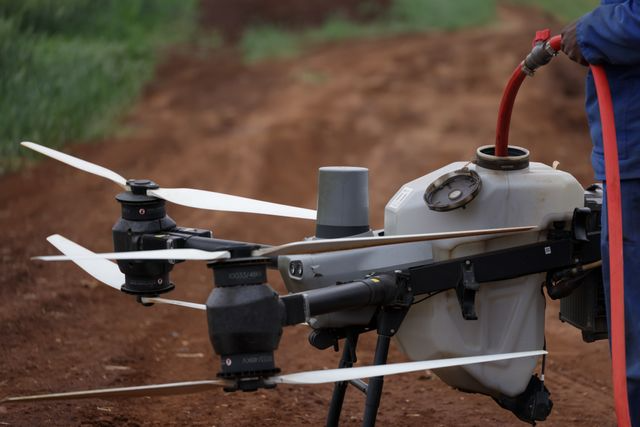
Introduction
Artificial intelligence is no longer a futuristic concept in agriculture. It is operational, field-tested, and delivering measurable returns — but adoption remains uneven.
The global AI in agriculture market reached $3.37 billion in 2026, growing at 24.5% annually, and is projected to hit $8.23 billion by 2030 . Yet only 14% of farmers report actively using AI tools today .
This gap between potential and adoption represents opportunity.
This post examines 10 AI technologies transforming farming in 2026 — from practical applications already proving ROI to emerging innovations that will define the next five years. Each technology includes implementation considerations for producers, cooperatives, and agribusinesses.
Technology 1: Physical AI Robotics (Autonomous Weeding)
What it is: Physical AI combines computer vision, edge processing, and purpose-built hardware to perform mechanical tasks autonomously — no cloud connection required.
How it works: Proprietary AI camera systems mounted on robots or retrofitted equipment identify crops versus weeds at millimeter accuracy, triggering precision mechanical or chemical action on weeds only.
Real-world deployment: Niqo Robotics achieved profitability in its first full commercial year (a first in agricultural robotics) with its RoboWeeder. The system processes thousands of plant-level decisions per second in real-time, with over 99% accuracy even in challenging field conditions .
ROI drivers:
- Zero recurring fees (one-time purchase)
- Eliminates manual weeding labor
- Reduces herbicide use by targeting only weeds
- Operates without cloud dependency (critical for rural connectivity)
Expansion trajectory: Niqo is expanding from lettuce into 15+ crops including onions, tomatoes, broccoli, kale, melons, and turf grass — plus new markets in the Pacific Northwest, Europe, and Australia .
The convergence trend → Physical AI generates verifiable data about field operations — application rates, weed pressure, crop health — that can be recorded on-chain for sustainability claims and carbon credit verification. The same robots that eliminate weeds can also prove they did.
Technology 2: Agentic AI for Precision Agriculture
What it is: Agentic Artificial Intelligence (AAI) uses intelligent software agents that act autonomously within defined parameters — monitoring, deciding, and triggering actions without constant human oversight.
Research validation: A 2026 study published by FAO/AGRIS demonstrated an AAI framework integrating federated learning for precision agriculture. The federated global model achieved 96.4% accuracy across disease classification tasks, outperforming individual client models .
Key capabilities:
- Distributed sensing devices communicate with intelligent agents
- Real-time monitoring and decision support at farm level
- Localized intelligence without sending farm data to central servers
- Federated learning improves models across farms without sharing raw data
Practical applications:
- Tomato disease classification (96.4% accuracy)
- Weed species detection ([email protected] of 0.978 using EfficientDet-D0)
- Autonomous irrigation scheduling
- Pest outbreak prediction
The convergence trend → Federated learning preserves farm data privacy while enabling collective model improvement — aligning directly with decentralized principles. On-chain model accuracy records could become verifiable credentials for AI-assisted farming claims. Farms contribute to better AI without surrendering data ownership.
Technology 3: Generative AI Agronomy Assistants
What it is: Conversational AI that acts as a decision partner, explaining recommendations, comparing scenarios, and answering agronomic questions in natural language.
How it works: Unlike traditional AI that operates "under the hood," generative AI allows farmers to ask "why was this recommendation made?" and receive understandable explanations .
Expected evolution in 2026:
- AI agents working across multiple systems (not confined to single vendor ecosystems)
- Scenario comparison (e.g., "what happens if I delay planting by 7 days?")
- Voice-based interaction for hands-free operation
Adoption context: Among larger farms using AI (5,000+ acres), 50% use it for business or financial analysis, while only 25% use it for yield prediction or agronomy — suggesting the office is where AI is currently adding value .
The convergence trend → AI-generated recommendations can be recorded on-chain, creating immutable records of decision-making processes — valuable for audit trails, compliance, and continuous improvement. When an AI recommends a planting date and the yield confirms it, that decision becomes verifiable proof of expertise.
Technology 4: Predictive Yield Analytics
What it is: Machine learning models that integrate satellite imagery, weather data, soil sensor readings, and historical yield information to forecast crop outcomes with increasing accuracy.
Market drivers: The applied AI in agriculture market — which includes predictive analytics — reached $4.86 billion in 2026, growing at 29.6% CAGR, and is projected to hit $13.57 billion by 2030 .
What makes 2026 different:
- Models trained on local data (not generic regional forecasts)
- Real-time integration of emerging conditions
- Increasing accuracy at zone level, not just field averages
Kansas State perspective: AI's ability to learn from a farm's own yield data, weather, soil tests, fertilizer rates, and management information enables variable-rate recommendations that turn field variability into an advantage .
The convergence trend → On-chain yield predictions create verifiable forecast histories. When combined with actual harvest data, this enables smart contracts that automatically adjust pricing or trigger insurance payouts based on objective comparisons. The prediction and the outcome both live on-chain — no dispute possible.
Technology 5: Targeted Spraying and Smart Chemical Application
What it is: Computer vision systems mounted on sprayers or tractors identify weeds in real-time and apply herbicide only where needed — replacing blanket field applications.
How it pays: This has a strong ROI use case because it targets a direct cost line item (chemicals) and reduces waste without changing the entire operation .
Green-on-green vs. green-on-brown:
- Green-on-brown: Identifies green plants against soil — weeds are targeted, crop row protected
- Green-on-green: Distinguishes crops from similar-looking weeds — more technically challenging but increasingly accurate
Economic impact: Beyond chemical savings, reduces environmental compliance costs and supports sustainability certification.
The convergence trend → Application records (date, location, rate, target) can be recorded on-chain as verifiable sustainability credentials — enabling premium pricing in markets demanding reduced chemical inputs. The sprayer proves it sprayed only the weeds, not the whole field.
Technology 6: Federated Learning for Privacy-Preserving Farm Intelligence
What it is: A distributed machine learning approach where models are trained across multiple farms without any farm sharing its raw data to a central server.
Why it matters: Agriculture data is sensitive. Farmers hesitate to share yield maps, input costs, and operational details. Federated learning solves this by sending model updates, not raw data.
Research validation: The FAO/AGRIS 2026 study demonstrated federated learning across tomato disease and weed detection datasets. The federated global model achieved higher accuracy than any individual farm's model, proving collective intelligence without compromising privacy .
Architecture components:
- Local models (DenseNet121, MobileNetV2, EfficientDet-D0, YOLOv8) run on farm hardware
- Only model weight updates are shared
- Central server aggregates updates without accessing farm data
The convergence trend → Federated learning aligns directly with decentralized agriculture principles. AgriGuildDAO could facilitate farmer-owned model improvement pools — farms collectively improve AI while retaining data sovereignty. The convergence of privacy-preserving AI and decentralized infrastructure creates a new category: collectively owned intelligence.
Technology 7: Computer Vision for Early Disease Detection
What it is: Machine learning models trained to identify nutrient deficiencies, disease signs, and pest pressure from images — enabling intervention before visible symptoms spread.
How it works: A producer captures photos in the field. The model, trained on labeled images (crop vs. disease vs. weed vs. healthy), recognizes patterns in shape, color, leaf structure, and texture .
Practical deployment:
- Drones paired with computer vision classify imagery to identify stressed plants
- Smartphone-based diagnostics allow rapid field scouting
- Models tested in one field, validated in another before scaling
Kansas State framework: Start with a clear objective, train with relevant local data, validate, then scale. If accuracy is not sufficient, more local data is added until performance is strong enough to trust .
The convergence trend → Disease detection records can trigger smart contract actions — automatic alerts to buyers, delayed shipment notifications, or quality certification adjustments. On-chain records of crop health become verifiable product attributes. The disease detection becomes a supply chain event, not just a farm note.
Technology 8: Autonomous Agricultural Machinery
What it is: Tractors, harvesters, and sprayers that operate without drivers — guided by GPS, sensors, and AI decision systems.
Current state: Automation performs well on repeatable tasks like mowing or tillage but struggles with whole-farm system understanding . Trust remains central — robots will not replace the relationship between a grower and a good agronomist.
Investment trend: Major OEMs (John Deere, CNH, Kubota, AGCO) are capitalizing on lower valuations to acquire or partner with autonomous technology startups.
Adoption patterns: Larger operations with scale advantages are adopting automation earlier. Smaller farms remain cautious pending clearer ROI evidence .
The convergence trend → Autonomous machinery generates continuous operational data — field conditions, application timing, harvest metrics — that can be recorded on-chain for verified supply chain claims. The tractor that works the field also certifies the work was done, when, and how.
Technology 9: AI-Integrated Livestock Monitoring
What it is: Intelligent monitoring systems using sensors, cameras, and machine learning to detect abnormal behavior, early illness symptoms, and welfare indicators in livestock operations.
Applications:
- Early disease detection (reducing treatment costs and mortality)
- Heat detection for breeding timing
- Feeding optimization based on individual animal performance
- Welfare compliance monitoring
Kansas State finding: Intelligent monitoring systems using sensors and video can detect abnormal behavior and early symptoms of illness, supporting welfare and performance outcomes .
The convergence trend → Livestock welfare data on-chain provides verifiable credentials for premium markets (grass-fed, humanely raised, antibiotic-free). Smart contracts could automatically certify compliance based on sensor data. The animal's health record becomes an asset, not an internal file.
Technology 10: Predictive Supply Chain and Timing Decisions
What it is: AI systems that improve decisions around harvest timing, storage, transport, and market timing — reducing spoilage and supporting more stable execution.
Practical applications:
- Optimal harvest windows based on weather and market price forecasts
- Storage rotation scheduling to minimize spoilage
- Transport routing to reduce fuel costs and emissions
- Market timing recommendations based on price trend analysis
Current adoption: Only 14% of farmers report using AI today, but early adopters are concentrated on business and financial applications. Among larger farms using AI, 50% use it for business or financial analysis — more than those using it for agronomy .
The shift from reactive to strategic: Experts at the 2026 World Agri-Tech Innovation Summit described AI as moving from operational efficiency to portfolio-style planning — choosing crops, inputs, and strategies based on modeled outcomes .
The convergence trend → On-chain timing and market decisions become auditable records. Smart contracts could execute automatically when AI-predicted optimal conditions are met — triggering harvest, transport, or sale without manual intervention. The AI decides; the blockchain executes; the farmer verifies.
How AI Adoption Actually Works in 2026
The Data: Who Is Using AI
The 2026 State of the Farm report (1,358+ farmer respondents) reveals :
| Metric | Finding |
|---|---|
| Farmers using AI tools today | 14% |
| Larger farms (5,000+ acres) using AI | Higher adoption than average |
| AI users willing to experiment | 70% (vs 42% non-AI users) |
| AI use for business/financial analysis | 50% of AI users |
| AI use for yield prediction/agronomy | 25% of AI users |
Key insight: AI adoption is highest for back-office and business applications — not in-field agronomy. The stereotype of the technology-averse farmer is false; farmers are willing to adopt when value is proven .
Where AI Pays Off First (According to Kansas State)
Kansas State University researchers identify these as the most practical, ROI-positive AI applications :
| Use Case | ROI Driver | Implementation Complexity |
|---|---|---|
| Targeted spraying | Direct chemical cost reduction | Low (retrofit existing equipment) |
| Variable-rate fertility | Input efficiency, yield improvement | Medium |
| Automated scouting | Labor savings, earlier intervention | Medium |
| Livestock monitoring | Mortality reduction, welfare compliance | Low |
| Harvest timing optimization | Spoilage reduction, quality improvement | Low |
The Real Constraints (Not Technology)
Industry leaders at the World Agri-Tech Innovation Summit identified the actual barriers to AI adoption :
1. Data fragmentation. AI's effectiveness depends on access to high-quality, integrated datasets, yet agriculture suffers from fragmentation across institutions, companies, and farms.
2. Farmer data ownership. Ownership of farmer-generated data is emerging as a critical economic and ethical issue.
3. Interoperability. Success depends on trust, interoperability, and the ability to break down silos — not better algorithms.
4. Ecosystem collaboration. No single entity — startup, corporation, or government — can drive this transformation alone .
The Future: Agentic AI and Decentralized Agriculture
The convergence of two trends will define the next phase:
Trend 1: Agentic AI Matures By 2027-2028, AI agents will work across multiple systems, not confined to single vendor ecosystems. They will explain recommendations, compare scenarios, and execute approved actions autonomously .
Trend 2: Data Ownership Becomes Competitive Companies that control or effectively utilize farmer data will have long-term advantages. But success depends on trust, interoperability, and breaking down silos .
The deeper convergence trend → Decentralized infrastructure offers a path where farmers retain data ownership while still benefiting from collective intelligence. On-chain records of AI decisions, predictions, and outcomes create verifiable histories — enabling accountability, auditability, and fair value distribution. The convergence of agentic AI and decentralized infrastructure creates something neither could achieve alone: autonomous systems that are also accountable systems.
Practical Takeaways
For Cooperatives and Producer Groups
| Priority | Action |
|---|---|
| Start with high-ROI use cases | Targeted spraying or variable-rate fertility before complex agronomy |
| Use existing data first | You already have yield history, soil tests, and application records |
| Pilot before scaling | One field, one crop, one season |
| Protect data ownership | Understand who controls the data your AI tools generate |
The FARM AI Act: Policy Supporting Adoption
In May 2026, U.S. Senators introduced bipartisan legislation — the FARM AI Act — to expand access to AI technology in agriculture .
Key provisions:
- Adding AI development as a Priority Research Area under USDA's Agriculture and Food Research Initiative
- Ensuring USDA Extension provides outreach and education on AI adoption
- Expanding agricultural workforce training to include AI and precision agriculture
- Nominating a senior USDA official to serve as AI in Ag advisor
Policy implication: Government support for AI in agriculture will accelerate in the next 12-24 months. Producers who adopt early will have first-mover advantage in accessing technical assistance and cost-share programs.
Conclusion
AI in agriculture is no longer experimental. The market is growing at 24-29% annually. Major players — Google, Microsoft, IBM, John Deere, Bayer — are invested. Early adopters are seeing ROI in targeted spraying, variable-rate applications, and business analytics.
But the technology alone is not enough. Real constraints remain: data fragmentation, farmer data ownership, interoperability, and ecosystem collaboration.
For decentralized agriculture platforms like AgriGuildDAO, these constraints are opportunities. On-chain verification of AI decisions and outcomes — immutable, auditable, farmer-owned — addresses exactly the trust and transparency gaps that limit AI adoption today.
The technologies in this post are real. They are deployed. They are paying for themselves. The question is no longer whether AI will transform farming — but who will control the data it generates, and how the value will be distributed.
The convergence trend → AI is becoming the brain of modern agriculture. Decentralized infrastructure is becoming the nervous system. Together, they create something neither can be alone: intelligent, accountable, farmer-owned food systems.
References
- AgriMarketing.com. (2026, January 5). Expert: Six Smart Tech Trends to Watch in Agriculture in 2026.
- Research and Markets. (2026, February). AI in Agriculture Market Report 2026.
- The Scoop. (2026, April 27). Farm Business in 2026: Relationship First, Digital Convenience Second.
- Adams Brown. (2026, March 25). AI on the Farm: Where It Actually Pays Off.
- Parvathaneni, N. S., et al. (2026). Agentic AI for smart and sustainable precision agriculture. FAO/AGRIS.
- Research and Markets. (2026, January). Applied AI in Agriculture Market Report 2026.
- Precision Farming Dealer. (2026, April 8). 2026 State of the Farm Report Examines Early AI Use and Broader Digital Trends in Agriculture.
- Precision Farming Dealer. (2026, May 31). Niqo Robotics AI Weeding Platform Expands into New Crops, Markets.
- AgriThority. (2026, April 26). Five Trends from World Agri-Tech Innovation Summit 2026.
- U.S. Senate. (2026, May 21). Cortez Masto Introduces Bipartisan Legislation to Expand Access to Technology for American Farmers and Ranchers.
Explore AgriGuildDAO → Farm data you own. Supply chain trust you control. Built on decentralized infrastructure.